 01273 761220


March 22, 2022 in
Business Relief Basics: Have you recently sold your company?
You might not know but whilst your company was trading, its value was outside of your estate for inheritance tax (IHT) purposes*. However, as...


September 30, 2026
When we last saw Brian and Carol, they had sold the business, taken the long holiday they had earned, and sat down with the family to talk about what came next. The mood was good. The freedom number was comfortably met. They had more than enough.
That part has not changed. They are still in a very fortunate position, and nothing about their day-to-day life is in question.
But something else has changed, and it has changed the picture considerably. It concerns what happens to everything they have built when they are both gone, and who ends up receiving it.
The Plan That Used to Work
For years, Brian and Carol had a quiet confidence about inheritance tax, because they had been well advised and had structured things sensibly.
Two parts of their wealth sat safely outside their estate. The first was the business itself. As a qualifying trading company, it attracted business relief, which meant its value fell outside the estate for inheritance tax purposes. The second was their pensions. On the advice they received years ago, they had deliberately built up their pensions during the profitable years, funnelling as much as they sensibly could into them. Under the rules as they stood, pensions passed to their children largely free of inheritance tax, which made them an ideal way to hand money down. The plan was simple: live off other assets, leave the pensions untouched, and pass them to the boys on death.
They also had a relevant life policy, a form of life cover held in trust and linked to the business, which would have paid out free of inheritance tax had anything happened to either of them while it was in force.
Between the business, the pensions and that protection, the plan felt sound. And it was, under the rules of the time.
Why It No Longer Works
Three things have quietly unpicked it.
When they sold the business, the shares turned into cash and investments on their personal balance sheet. The business relief that had kept those assets out of the estate fell away the moment the sale completed. What had been outside the estate was now firmly inside it.
When the business went, so did the relevant life policy attached to it. That was a loss of protection rather than a loss of an asset, but it mattered: a sum that would once have been paid out, in trust and outside the estate, was simply no longer there.
And then the significant one. From April 2027, pensions are due to form part of the estate for inheritance tax. The very pots Brian and Carol had earmarked as their tax-efficient legacy, the money they had promised themselves they would leave untouched for the children, will, on the second death, be counted alongside everything else.
Put those three changes together and the shift is considerable. Assets that were comfortably outside their estate are now inside it. Their taxable estate has not grown because they spent recklessly or made a mistake. It has grown because the goalposts moved and a business was sold. But the result is the same: a much larger inheritance tax bill, and a much larger slice heading to HMRC.
HMRC, It Turns Out, Is a Beneficiary
There is a useful way to picture this.
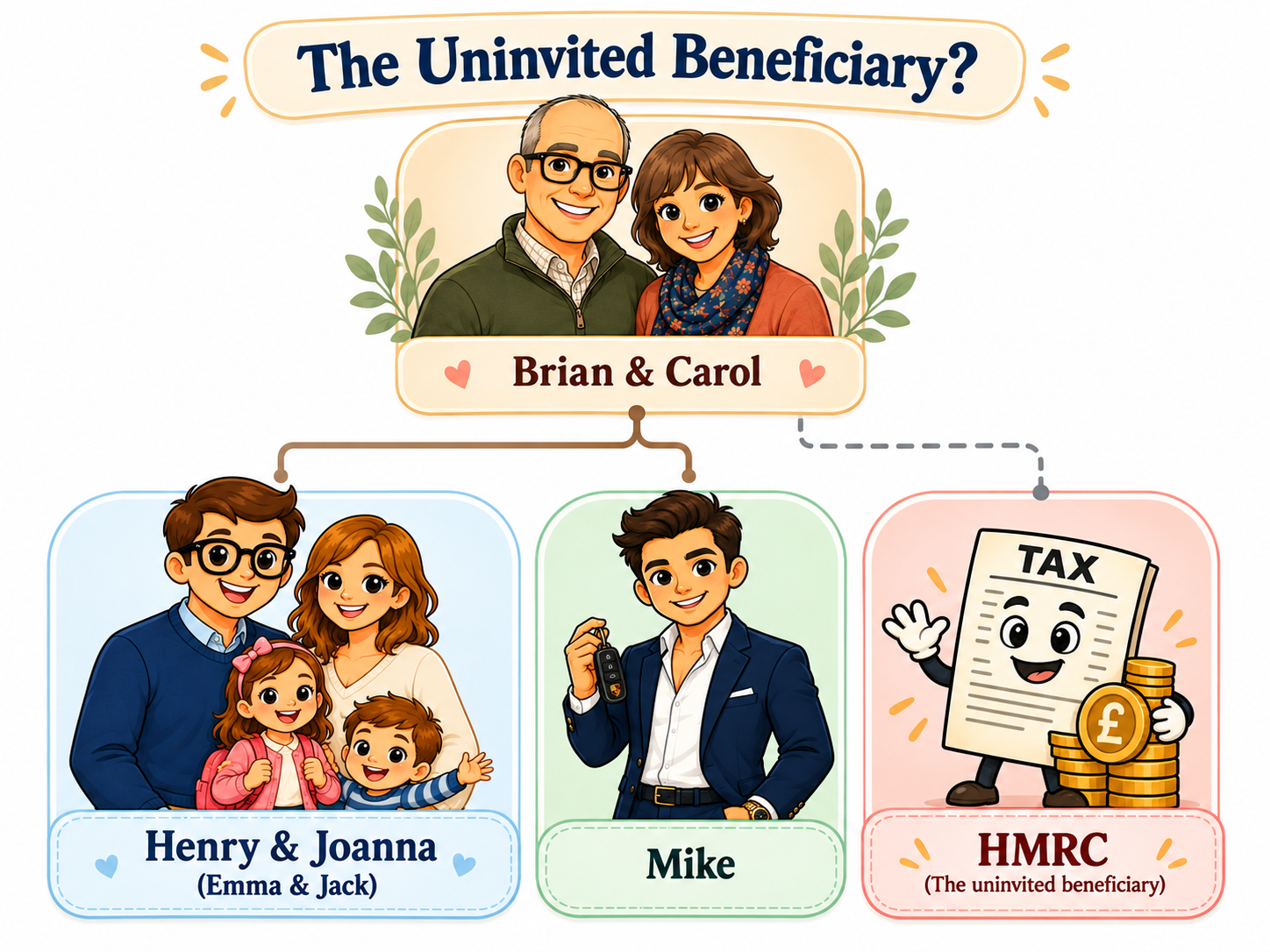
Draw the family tree. Brian and Carol at the top. Their two sons. The grandchildren. It is a lovely picture, and it is exactly who they imagine benefiting from a lifetime of work.
The trouble is that, as things now stand, there is another name on that tree that nobody invited. HMRC sits there as one of the largest single beneficiaries of the estate.
This is no longer a niche worry for the very wealthy. Inheritance tax receipts have risen from £4.6 billion in 2015-2016 to a record £8.7 billion in 2025-2026, close to double in a decade. More and more families are being drawn into a tax that, not so long ago, relatively few people ever paid. The pension change from 2027 will only add to that.
A Worked Illustration
Consider a couple in Brian and Carol’s kind of position. A house worth, say, three million pounds. Two million in pensions. Another million or so in cash and investments. Comfortably over six million pounds in total.
On the second death, after the available allowances, an estate of that size faces an inheritance tax bill running well into seven figures. HMRC’s share can comfortably exceed two million pounds.
It is worth being clear: their sons are doing very well in their own right. They could, if it came to it, meet the bill. This is not a story about a family unable to pay. It is a story about magnitude. It is about the sheer size of the slice that leaves the family altogether, when a good deal of it could have stayed within it through some straightforward, legitimate planning done in good time.
(These figures are illustrative, and every estate is different. The allowances involved are also less generous than many people assume. The main residence nil-rate band, for instance, is gradually withdrawn once an estate exceeds two million pounds, so higher-value estates often lose it altogether.)
An Allowance Worth Knowing About
Here is where the conversation turns from problem to plan.
Most of us know our allowances. The ISA allowance. The pension annual allowance. The personal allowance. We are encouraged to use them, and leaving them unused feels like a small waste.
There is another allowance that far fewer people know about, and it is relevant to a couple in Brian and Carol’s position.
Investments that qualify for business relief can, once they have been held for a minimum of two years, be valued at nil for inheritance tax. It is worth being precise about what that means, because it is easily misunderstood. The assets still form part of the estate, but provided the conditions are met, no inheritance tax is charged on them. They are zero-rated, not removed.
A quick word on the term “allowance,” because it does not work quite like the others. Your ISA and pension allowances are annual, use-it-or-lose-it amounts. Business relief is not an annual allowance in that sense. But it is still, in effect, a relief the rules make available to those whose circumstances fit, and there is a limit to how much can benefit from the full relief. The reason the “allowance” framing is useful is simply that it prompts a sensible question: this exists, it may fit my circumstances, so why would I not at least look at whether it has a place in my plan?
For a couple whose estate has grown through no fault of their own, purely because the rules changed and a business was sold, that is a very reasonable question to ask. And having recently sold a qualifying business, Brian and Carol may have some time-sensitive options open to them that are worth taking advice on sooner rather than later. The detail of how that works is a conversation for a planner, not a paragraph in an article.
The Important Caveats
Business relief investments are not a magic wand, and it would be wrong to present them as one.
They are investments, and they carry investment risk. The value can fall as well as rise, and there have been cases over the years where poorly managed schemes disappointed. They are not a place to chase high returns; well-run ones tend to invest in relatively stable, asset-backed areas such as infrastructure and forestry, aiming for modest, steady returns rather than spectacular ones. The point of them is not the investment return. The point is the tax treatment, alongside the access and control they keep compared with simply giving money away.
That last part matters. Unlike an outright gift, money in a business relief investment remains theirs. They keep access to it. If, years from now, one of them needed expensive care and the other needed to draw on those funds, the money is there to be used. It has not left their hands. That combination, potentially zero-rated for inheritance tax yet still within reach if life takes an unexpected turn, is what makes it worth understanding.
It is different from placing assets in trust. Business relief keeps the money zero-rated while it stays in the qualifying investment, but the assets remain part of the estate. Moving assets into trust is what genuinely takes them outside the estate altogether, though only after a seven-year clock has run, and in return for less flexibility. Some couples eventually use both in sequence. That, too, is a conversation for another day.
And one principle sits above all of it: the tax should never drive the decision. These choices should follow from a family’s own circumstances and wishes, not the other way around. Business relief is worth understanding precisely because it can fit naturally into a wider plan, not because anyone should reshape their life around a relief.
The Point Is the Plan, Not the Product
It would be a mistake to read this as “the answer is a business relief scheme.” It is not. Business relief is one option among several, and it belongs inside a broader plan, not on its own.
The rest of that plan is the ordinary, sensible business of using what is available. Continuing to spend and enjoy their money, which remains the happiest form of estate planning there is. Making use of the annual gift exemption of three thousand pounds each per year. Small gifts to the grandchildren. Tax-free gifts to charity, which, if structured generously enough, can even reduce the rate of inheritance tax on the rest of the estate, a subject worth a post of its own another time.
No single one of these solves the problem on its own. Together, and started in good time, they can change the outcome meaningfully, and quietly move HMRC back down the list of beneficiaries, where the family would much prefer it to sit.
The Real Message
Brian and Carol’s situation is a good news story wrapped around a warning.
The good news is that they have plenty, that their children are thriving, and that they have the time and the means to plan properly. The warning is that even a well-advised, sensibly structured plan can be overtaken by changing rules, and that inheritance tax is now reaching families who never expected to pay it.
The lesson is not to panic, and certainly not to rush into any single product. It is to look at the whole picture, with the rules as they now are rather than as they used to be, and to do it in good time. For anyone with pensions they had assumed would pass on tax-free, the April 2027 change is reason enough to revisit the plan.
Nobody can keep HMRC off the family tree entirely (above NRB+RNRB thresholds). But with some thought, and some time, you can usually make sure it is not one of the largest names on it.
Coming Next in The Life of Henry
Next time, we stay with the theme of giving, and look at one of the most satisfying forms of planning there is: charitable giving that supports a cause the family cares about and reduces the inheritance tax bill at the same time.
Henry’s story continues.
Brian, Carol, Henry, Joanna and the wider family are fictional characters. The themes explored in this series are drawn from many years of client conversations and observations across the financial planning profession, but no individual client is depicted and no real names are used.
This article is for information purposes only and should not be construed as tax, investment or financial advice. Business relief investments carry risk and are not suitable for everyone. Individual circumstances vary and tax legislation may change. For personalised advice, please speak to a regulated financial planner.
March 22, 2022 in
You might not know but whilst your company was trading, its value was outside of your estate for inheritance tax (IHT) purposes*. However, as...